## Miftah Ismail Raises Serious Concerns Over New Net Metering Policy
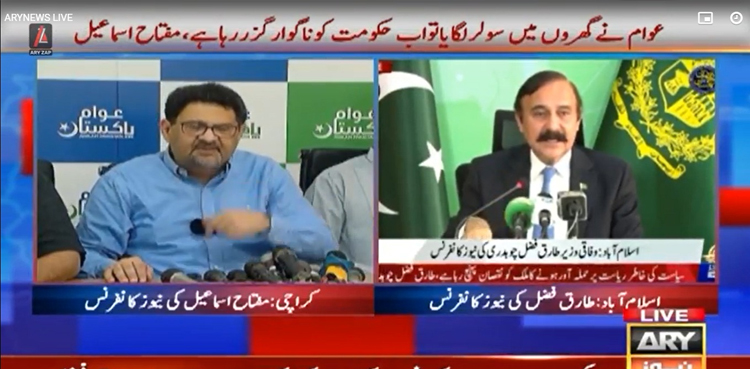
Former Finance Minister and economist Miftah Ismail has slammed the government’s newly implemented net metering policy, which significantly reduces the price at which solar electricity is bought back in Pakistan. Speaking at a press conference in Karachi, Ismail argued that the policy is not only unfair but will also ultimately increase the financial strain on electricity consumers.
Ismail highlighted a sharp contradiction in the government’s approach. He pointed out that Prime Minister Shehbaz Sharif had previously championed solar energy adoption, encouraging the public to embrace renewable sources. However, as more consumers transition to solar and reduce their reliance on the national grid, the government now appears to view this shift as a problem.
Ismail criticized the government’s overall policies as “deeply flawed,” blaming a group of “over two dozen” decision-makers within the government for increasing the burden on consumers. He further demanded that Prime Minister Shehbaz Sharif explain who authorized the installation of expensive power plants, implying that these past decisions were driven by greed.
The former finance minister asserted that the government is breaking its agreements with net metering consumers, forcing them to pay over 10% in taxes on both the sale and purchase of their own solar-generated electricity. He identified the country’s reliance on expensive power plants as the core issue.
The Economic Coordination Committee (ECC) of the Cabinet recently approved amendments to existing net-metering regulations, aiming to lessen the financial impact on grid consumers. These changes include lowering the buyback rate from the National Average Power Purchase Price (NAPP) to Rs 10 per unit. Furthermore, the ECC granted the National Electric Power Regulatory Authority (NEPRA) the power to periodically revise this buyback rate. The goal is to keep the system adaptable to the changes in market.